
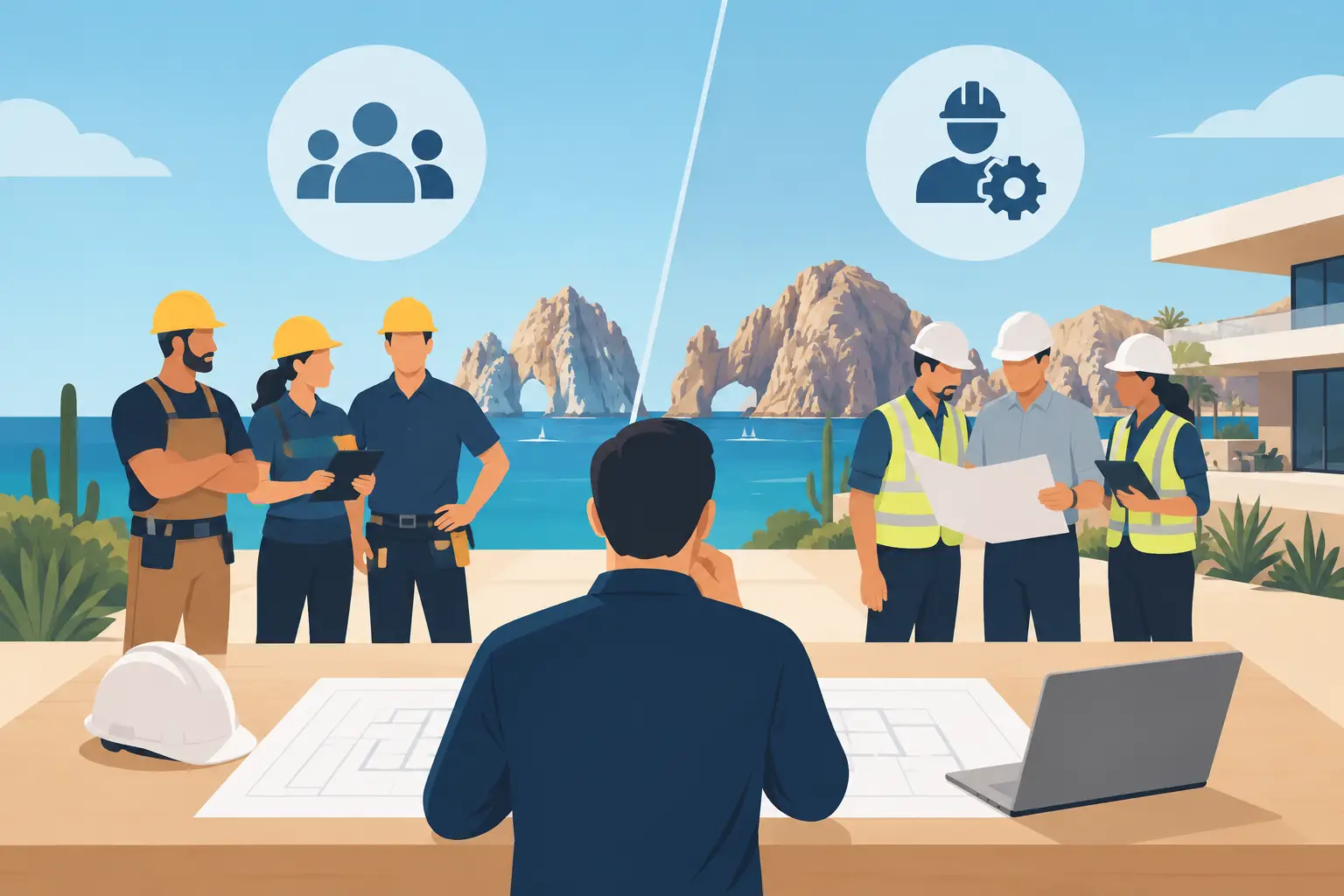
A luxury home in Los Cabos can look exceptional at final delivery while hiding a difficult question beneath the finishes: who actually built it? An in-house labor comparison gives property owners a practical way to assess that question before construction begins. For buyers managing a project from the United States or Canada, the answer affects quality, schedule, communication, warranty response, and confidence in every phase of the work.
Many contractors can present attractive renderings and competitive budgets. The meaningful difference often appears when plans need clarification, materials arrive late, an inspection reveals an issue, or a specialty system needs coordination. A builder with direct control over its trade teams approaches those moments very differently than one assembling separate subcontractors for each scope.
What an In-House Labor Comparison Really Measures
An in-house labor comparison is not simply a headcount exercise. It compares how a contractor manages the people performing the work against a model where most work is assigned to independent subcontractors. Neither model is automatically good or bad. The right choice depends on the contractor’s standards, project management, local relationships, and ability to take responsibility when something needs correction.
For a custom home, however, labor structure matters because construction is a chain of connected decisions. The architect, structural calculation engineer, concrete crew, plumber, electrician, carpenter, tile installer, pool technician, and solar team all affect one another’s work. If these trades operate as separate businesses with separate schedules and limited oversight, the owner can become the person left waiting for answers.
An in-house team gives the general contractor more day-to-day visibility. The builder can assign priorities, verify workmanship before the next trade begins, and coordinate changes without relying on several outside companies to realign their schedules. That operational control is especially valuable in Los Cabos, where many owners are not able to visit the site every week.
The Difference Shows Up in the Details
A custom residence in Palmilla, Puerto Los Cabos, Querencia, Pedregal, Diamante, Chileno Bay, Campestre, or the East Cape is not a standard production build. Ocean exposure, hillside conditions, high-end finishes, outdoor living areas, pools, solar systems, and smart-home requirements create interdependent scopes of work. Small coordination failures can lead to expensive rework.
Consider a simple example: exterior lighting around a pool and terrace. The electrical layout must align with the pool equipment, waterproofing, stonework, drainage, landscaping, and architectural lighting plan. If each team arrives independently and the communication path runs through multiple subcontractors, a late change can delay several scopes. When the builder has electricians, pool technicians, designers, and site supervision working within one organization, there is a clearer path to resolve the issue before finished materials are affected.
This does not mean an in-house model eliminates every delay. Weather, imported materials, permit timing, homeowner selections, and community requirements can all influence a schedule. It means the contractor has more direct ability to identify the issue, explain its impact, and organize a response.
Quality Control Is a Daily Process
Quality control is not a final walk-through with a punch list. It begins with layout verification, material selection, proper installation methods, and inspections at each stage. A builder that directly employs key trades can establish common expectations for workmanship, safety, site cleanliness, documentation, and code compliance.
For U.S. and Canadian owners, this familiarity matters. Many clients want construction practices that reflect the standards they know at home while respecting the requirements and realities of Baja California Sur. They expect properly planned electrical systems, dependable plumbing, engineered structural work, and details built to perform in a coastal climate.
An in-house workforce also makes training and accountability more immediate. If a finish does not meet the agreed standard, the contractor is not merely requesting a favor from an outside crew. The contractor can inspect the work, direct the correction, and confirm that the resolution protects the schedule and the larger project.
Schedule Reliability Requires Control, Not Promises
Every builder can say a project will be on time and on budget. The more useful question is how the company manages the work required to make that possible.
Subcontractor-heavy models can work well when a contractor has long-standing trade relationships and a disciplined project manager. But they can become vulnerable when demand is high, a subcontractor accepts another job, or a specialized crew is unavailable at the critical moment. Delays then cascade. Drywall waits for mechanical work, cabinetry waits for drywall, and final finishes wait for cabinetry.
With in-house trades, the contractor has greater flexibility to sequence work around site conditions and project priorities. A team can shift resources, bring a supervisor into the decision earlier, and coordinate trades from a common schedule. That does not create unrealistic guarantees, but it creates a more accountable system for managing the variables that do arise.
For an absentee owner, clear communication is equally important. You should receive direct updates on progress, decisions, budget changes, selections, and upcoming milestones. You should not need to call individual electricians, plumbers, or specialty installers to understand why a room is delayed. One accountable construction partner should own that conversation.
Where Specialty Subcontractors Still Make Sense
A balanced in-house labor comparison should recognize that specialized subcontractors can bring real value. Certain scopes may require a manufacturer-certified installer, a highly specific fabricator, a local utility connection specialist, or a trade with uncommon equipment. The strongest builders do not avoid outside specialists when they are the best fit for the job.
The deciding factor is not whether every person carries the same company name on a shirt. It is whether the general contractor retains ownership of coordination, standards, inspection, scheduling, and warranty support. Outside specialists should strengthen the project team, not create a gap in responsibility.
Ask a prospective builder which scopes are performed by direct employees and which are subcontracted. Then ask who supervises each scope, who verifies quality before payment, who coordinates design changes, and who responds if a problem appears after occupancy. Straight answers to these questions reveal much more than a proposal price alone.
Questions to Ask Before You Choose a Builder
Before signing a construction agreement, look beyond architectural style and estimated cost. Ask how often the site is supervised and whether the supervisor has authority to make decisions. Ask whether the company has in-house architects, engineers, electricians, plumbers, carpenters, designers, pool technicians, and solar professionals, or whether these services are sourced separately.
You should also ask how the builder handles changes. Custom homes evolve as owners refine finishes, add technology, reconsider a terrace layout, or respond to site conditions. A change process should document the scope, cost, schedule impact, and approval before work proceeds. This protects both the client and the builder.
Finally, ask about completed homes similar to yours. A contractor with experience in luxury residences, renovations, pools, commercial spaces, inspections, and energy upgrades can bring useful perspective to planning. Experience matters most when it is backed by a team that can carry decisions through to the field.
Direct Accountability Has Long-Term Value
The labor structure behind a project affects more than construction day-to-day. It can shape your experience after move-in. Homes in Los Cabos require knowledgeable attention to salt air, seasonal weather, water systems, pool equipment, air conditioning, solar performance, and outdoor finishes. When the original builder has direct teams and established specialty capabilities, service questions have a clearer path back to the people who understand the property.
Custom Homes Mexico operates as a one stop shop because clients need fewer handoffs and more certainty. Its in-house architects, calculation engineers, licensed trade professionals, carpenters, designers, pool technicians, and solar engineers work with hands-on project leadership from planning through final delivery. That structure supports the principles that matter most in a cross-border investment: Trust – Communication – Value.
The right builder will not claim that construction has no surprises. A trustworthy builder will show you who is responsible when they occur, how decisions are documented, and how the team protects your investment. For a home you may enjoy for decades, direct accountability is not an extra feature. It is part of the foundation.