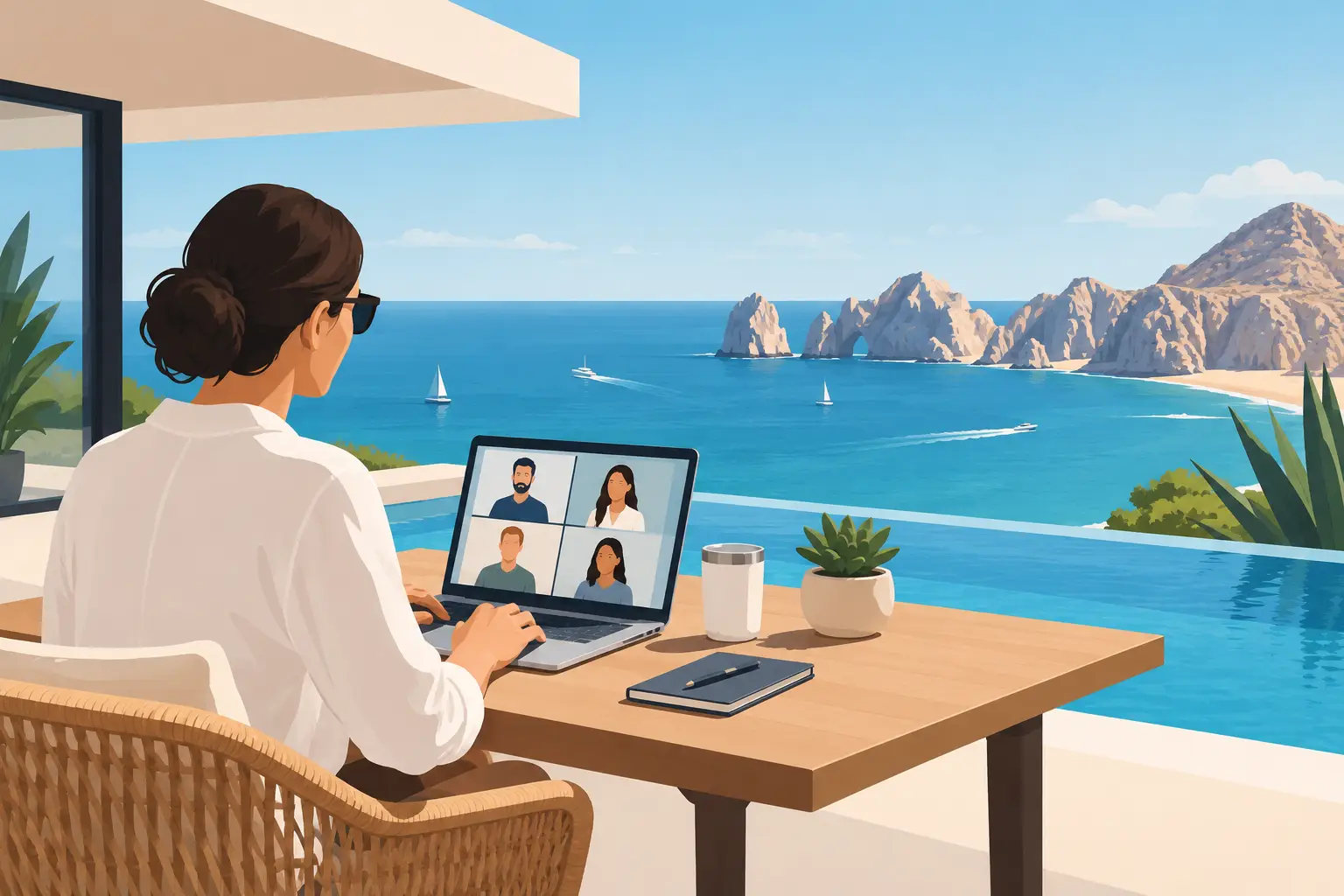
A build should not become a black box the moment you fly home. This remote build case study follows a representative Los Cabos homeowner who owns a view lot, lives in North America, and needs a custom residence delivered with clear decisions, visible progress, and one accountable team on the ground.
That situation is common in Palmilla, Puerto Los Cabos, Querencia, Chileno Bay, Pedregal, Diamante, Campestre, and the East Cape. The opportunity is exceptional, but distance changes the owner’s role. You cannot casually stop by to confirm a rough-in, review tile placement, or ask why a delivery is late. The builder’s systems, people, and communication standards become part of the home you receive.
The Project: A Home Managed From Another Country
Our representative owner is a Canadian couple planning a modern, three-bedroom Los Cabos residence for seasonal living, family visits, and occasional entertaining. Their priorities are familiar: protected ocean views, shaded outdoor living, a pool, efficient cooling, dependable water systems, and finishes that feel considered without becoming difficult to maintain.
They have the land but are not in Cabo full-time. They can visit at key milestones, but they do not want construction to depend on constant travel. Their central question is not simply, “Can this home be built?” It is, “How will we know it is being built correctly when we are away?”
The answer starts before excavation. Remote construction is not solved by sending more photographs after work is complete. It is solved by establishing scope, responsibility, approval paths, and quality expectations before crews begin work.
Remote Build Case Study: Start With the Right Controls
For an owner building from the United States or Canada, the preconstruction phase is where uncertainty is either reduced or carried into the job site. A clear design-build process brings architectural planning, engineering coordination, permitting requirements, budget review, and construction sequencing into one conversation.
The homeowner first works through how the home will actually be used. A dramatic open-air terrace may be perfect for winter entertaining, for example, but it needs proper drainage, durable finishes, thoughtful wind exposure, and shade planning. Floor-to-ceiling glass can frame a view, yet it also affects solar heat gain, privacy, structural requirements, and the capacity of the cooling system.
These are not reasons to avoid ambitious design. They are reasons to make informed choices early, when changes cost less and protect the schedule. The team should translate design intent into buildable details, not leave essential decisions for field crews to interpret later.
A well-managed remote project also establishes a documented scope. That includes the approved drawings, engineering requirements, material allowances or selected products, equipment specifications, pool scope, exterior work, and the owner’s approval process for changes. When a decision is outside that scope, it should be discussed directly with its cost and schedule implications.
There is a trade-off here. Finalizing more details before construction can take longer at the beginning. But it typically reduces costly revisions during framing, mechanical work, and finish installation. For a remote owner, that added preconstruction discipline is usually worth it.
One Team, Not a Chain of Unknowns
A custom home is a sequence of interdependent systems. Concrete and structure affect window openings. Plumbing and electrical rough-ins affect cabinetry and lighting. Waterproofing affects tile, exterior walls, and pool performance. If each trade is managed separately with little accountability, small misses can become expensive rework.
That is why an in-house workforce matters. At Custom Homes Mexico, architects, calculation engineers, electricians, plumbers, carpenters, designers, pool technicians, solar engineers, and specialty trades work within a single operating structure. The goal is simple: fewer handoffs, clearer responsibility, and quicker action when site conditions require attention.
For this representative project, the construction team holds internal coordination meetings before each major transition. Before a slab is poured, the relevant sleeves, drains, electrical runs, and plumbing penetrations need to be confirmed. Before walls are closed, rough-ins need to match the approved plans and the realities of the selected fixtures, lighting, and cabinetry.
This is where familiar North American standards are especially valuable to foreign owners. Clear code compliance, qualified technical oversight, and experienced trade professionals provide a benchmark beyond appearances. A beautiful finish cannot correct an undersized electrical plan, a poorly sloped shower, or insufficient waterproofing behind a wall.
Communication That Gives Owners Something Useful
Weekly updates are valuable only when they help an owner understand what happened, what comes next, and whether a decision is needed. A folder of disconnected job site photos may prove that people were present. It does not necessarily prove that the work is aligned with the plan.
In this case, reporting is organized around the construction schedule. The owner receives progress photographs and video, a plain-language update on completed work, upcoming activities, current decisions, and any issue that could affect cost or timing. A remote walk-through can be scheduled at meaningful stages, such as after structural work, rough-ins, waterproofing, millwork installation, or major finish completion.
The builder should not wait for a homeowner to discover a question in a photo. If a selected material is delayed, if a field condition changes the intended installation, or if a design request adds scope, the owner needs a direct explanation. What is the issue? What are the options? What does each option mean for the budget and schedule?
That approach protects Trust – Communication – Value. It also respects the owner’s time. Most clients do not want to manage crews from another country. They want enough information to make sound decisions without being forced to become the project manager.
A Realistic View of Budget and Schedule
No responsible builder should promise that every custom project will remain unchanged from the first concept to final delivery. Site conditions, owner upgrades, utility coordination, imported materials, weather, and permitting can all affect a project. The question is how those variables are managed.
In this remote build case study, the couple initially considers a more elaborate outdoor kitchen and a larger solar package. Both may add long-term value, but both need to be evaluated against construction timing, equipment requirements, and the overall investment plan. Rather than treating those choices as casual additions, the team prices and reviews them before authorization.
Change control protects everyone. The homeowner should see the proposed change, understand why it is being considered, and approve the cost and schedule impact before work proceeds. This is especially important when the owner is away, because informal conversations on site can easily lead to misunderstandings.
Schedule reliability also depends on sequencing. Selecting appliances, plumbing fixtures, lighting, doors, stone, and specialty finishes too late can put pressure on the final phase of construction. Some owners prefer maximum flexibility and are comfortable with more decisions later. Others prefer to make selections early to protect the delivery date. Neither approach is wrong, but the schedule should reflect the choice.
Quality Checks Before the Finish Line
The most visible part of a luxury home is often the finish work, but many of the most important checks occur before the finishes cover the systems beneath them. Structural work, electrical capacity, plumbing pressure, drainage, waterproofing, pool equipment, and mechanical planning all require careful review during construction.
For a Los Cabos home, exterior durability deserves particular attention. Salt air, intense sun, seasonal rain, wind, and periods of vacancy all influence material selection and installation details. The right solution depends on the location, exposure, and how the house will be occupied. A beachfront property may need a different approach than a protected home in an established community.
Near completion, the owner should receive a structured walk-through rather than a rushed handoff. This is the time to identify finish adjustments, review systems, confirm pool operation, discuss maintenance needs, and document remaining punch-list items. If solar, smart-home features, or specialized equipment are included, the owner also needs a clear explanation of operation and service planning.
A final walk-through is not merely ceremonial. It is the practical handoff of a significant cross-border investment.
What This Means for Your Los Cabos Build
Building remotely does not mean giving up control. It means choosing a construction partner with the people, processes, and accountability to carry the project forward when you are not on site. Ask who will manage the work daily, which trades are in-house, how changes are documented, how quality is checked, and what your updates will actually include.
The best time to establish those answers is before plans become permits and before permits become concrete. A home built on clear expectations is easier to manage from afar and far more enjoyable to arrive at when the work is complete.