
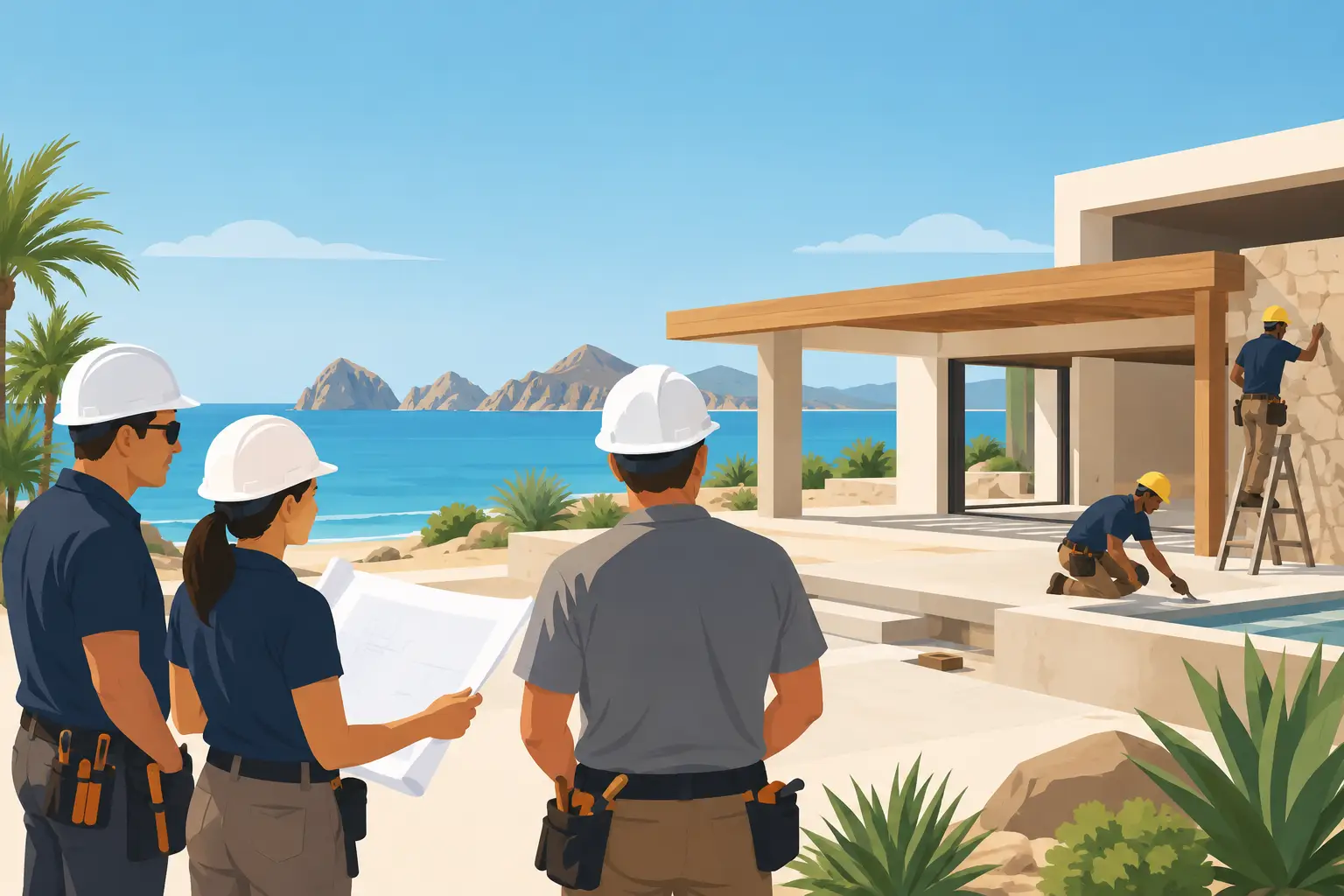
A luxury home in Los Cabos may look effortless when it is finished: clean lines, ocean-facing glass, a pool that blends into the horizon, and outdoor spaces made for entertaining. Getting there requires hundreds of decisions behind the walls and beneath the finishes. That is why hire in-house trades is more than a staffing question. For an owner managing a high-value property from the United States or Canada, it is a question of who is truly accountable for the result.
When architects, engineers, electricians, plumbers, carpenters, pool technicians, and solar specialists work under one contractor, the project has a single operating standard. Communication is faster, quality checks are more consistent, and problems can be resolved before they become expensive delays.
Why Hire In-House Trades for a Los Cabos Home?
Custom construction is a chain of connected work. The electrical layout affects cabinetry and lighting. Plumbing decisions affect slab penetrations, waterproofing, and tile placement. Structural requirements influence window openings, shading systems, and the location of a rooftop solar array. A project can only move as smoothly as the coordination between those trades.
A subcontractor-heavy model can work on the right project, especially when a specialist is needed for a narrowly defined scope. But it also creates more handoffs. Each separate company may have its own schedule, purchasing process, crew availability, and interpretation of the plans. When something does not line up, the owner can be left trying to determine where responsibility starts and stops.
An in-house team changes that dynamic. The builder manages the people performing the work, not simply a collection of outside contracts. That creates clearer accountability from initial planning through final delivery. If a plumbing rough-in conflicts with an electrical run, the team can address it internally, using the same schedule and the same project priorities.
For foreign owners, that control matters even more. You should not have to coordinate a plumber, electrician, pool crew, and designer across borders or wonder who is visiting the site this week. A one stop shop gives you one responsive team and one clear point of contact.
Better Quality Control Starts Before Construction
Quality is not something added during a final walkthrough. It is established when the team reviews drawings, defines construction details, coordinates engineering, and plans the order of work.
In-house trades allow those conversations to happen earlier and more often. A calculation engineer can work directly with the construction crew on structural requirements. The electrician can review lighting plans with the designer before walls are closed. Pool technicians can coordinate equipment access and drainage with the landscaping and plumbing teams. These are practical details, but they protect both the design and the long-term performance of the home.
This matters in Los Cabos, where homes face intense sun, salt air, seasonal rain, wind exposure, and periods of vacancy. Materials, waterproofing details, mechanical systems, drainage, and exterior finishes need to be selected and installed for local conditions. A beautiful finish is not enough if the assembly behind it cannot handle the environment.
A contractor with an established in-house workforce can apply consistent installation standards across the project. That does not mean every decision is identical from home to home. A modern villa in Chileno Bay has different needs than a hillside residence in Pedregal or a family retreat on the East Cape. It means the team follows an organized process for reviewing details, inspecting work, documenting changes, and correcting issues while they are still manageable.
North American Expectations, Local Execution
Many clients choose Los Cabos for its lifestyle but want construction management that feels familiar. They expect direct answers, documented scope, realistic schedules, and workmanship aligned with U.S. and Canadian standards. They also want a local team that understands permitting, local supply chains, climate conditions, and the practical realities of building in Baja California Sur.
That combination is valuable. Red Seal-certified professionals and experienced local trades bring technical discipline to the job while remaining available on the ground. Rather than trying to import every solution, the right builder applies proven standards to the conditions of the site.
Schedule Control Is About More Than Speed
No responsible builder should promise that every custom project will be free of changes or supply challenges. Luxury homes often evolve during construction, and certain materials may require careful lead-time planning. The goal is not to pretend those realities do not exist. The goal is to manage them without losing control of the project.
In-house crews give the contractor more flexibility when priorities shift. If an owner decides to add architectural lighting, revise a guest suite, redesign a pool feature, or prepare for solar installation, the team can evaluate the effect on the schedule immediately. Internal coordination helps determine what can proceed, what needs to be reordered, and how to avoid unnecessary rework.
By contrast, when every trade is independent, a single late change can create a long sequence of rescheduling. One crew may need to leave for another job. The next crew cannot begin until the first returns. Those gaps add up quickly, particularly in busy building seasons.
This is one reason schedule reliability depends on workforce structure, not just a project calendar. A detailed schedule is essential, but it only works when the contractor has the operational ability to direct the people and materials required to meet it.
Cost Transparency and Real Value
Hiring in-house trades is not always the lowest initial-price approach. A low bid can look attractive when it excludes supervision, quality checks, coordination, warranty responsibility, or proper planning. The cost becomes clearer later, when changes, repairs, delays, and missing scope appear.
Value comes from knowing what is included and who stands behind it. With an integrated team, the contractor can price scopes with a better understanding of labor requirements, construction sequencing, and potential conflicts. That supports more accurate budgeting and more useful conversations when a client is deciding where to invest.
For example, a homeowner may be choosing between a standard pool finish and a more complex waterline detail, or between basic electrical allowances and a whole-home lighting control system. An experienced in-house team can explain how each choice affects installation, maintenance, and future service – not just the immediate price.
Clear change management is equally important. Clients should know when a decision changes the scope, how it affects timing, and what approval is needed before work moves forward. Trust – Communication – Value is not a slogan when it is supported by documented decisions and active site management.
One Team Makes Service Easier After Delivery
The relationship with your builder does not end when the keys are handed over. New homes need seasonal checks, equipment orientation, adjustments, and occasional service. Pools, solar systems, plumbing fixtures, electrical controls, and exterior finishes all benefit from a team that understands how they were installed.
When the original contractor has in-house specialists, post-construction questions do not have to bounce between unrelated vendors. The team has project knowledge, records, and direct access to the people responsible for the work. That can make a meaningful difference for owners who use their Cabo home seasonally or rent it when they are away.
It also provides practical support for renovations. A home inspection may reveal an opportunity to improve drainage, replace aging pool equipment, update lighting, or add solar capacity. The same builder can assess the existing conditions and coordinate the right trades without starting from zero.
When Outside Specialists Still Make Sense
An in-house model should not mean a contractor refuses outside expertise. Certain custom items, proprietary systems, or highly specialized finishes may require a manufacturer-approved installer or a niche craftsperson. That is often the right choice.
The difference is in who manages that specialist. A capable general contractor brings outside expertise into an organized process, verifies scope, coordinates access, reviews the work, and keeps the specialist aligned with the larger build. The owner still has one accountable partner rather than another separate relationship to manage.
For Custom Homes Mexico, maintaining architects, engineers, and skilled trades within the company is a commitment to hands-on delivery, not a claim that every project is identical. It allows the team to maintain control where control matters most while bringing in specialty support when it adds genuine value.
Choose Accountability, Not Just Availability
Before selecting a builder, ask who will actually perform the critical work, who supervises each phase, and who is responsible if plans and field conditions do not match. Ask how changes are documented, how quality is inspected, and who will answer the phone after delivery. The answers reveal far more than a polished proposal.
Your Los Cabos home deserves a builder whose team is present from the first design conversation through the final detail. When the people planning, building, and servicing the home work together, you gain more than convenience. You gain a clearer path to a home delivered with the care, communication, and accountability your investment deserves.