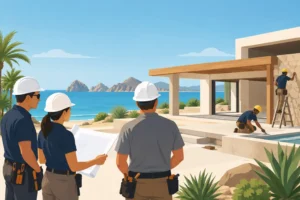
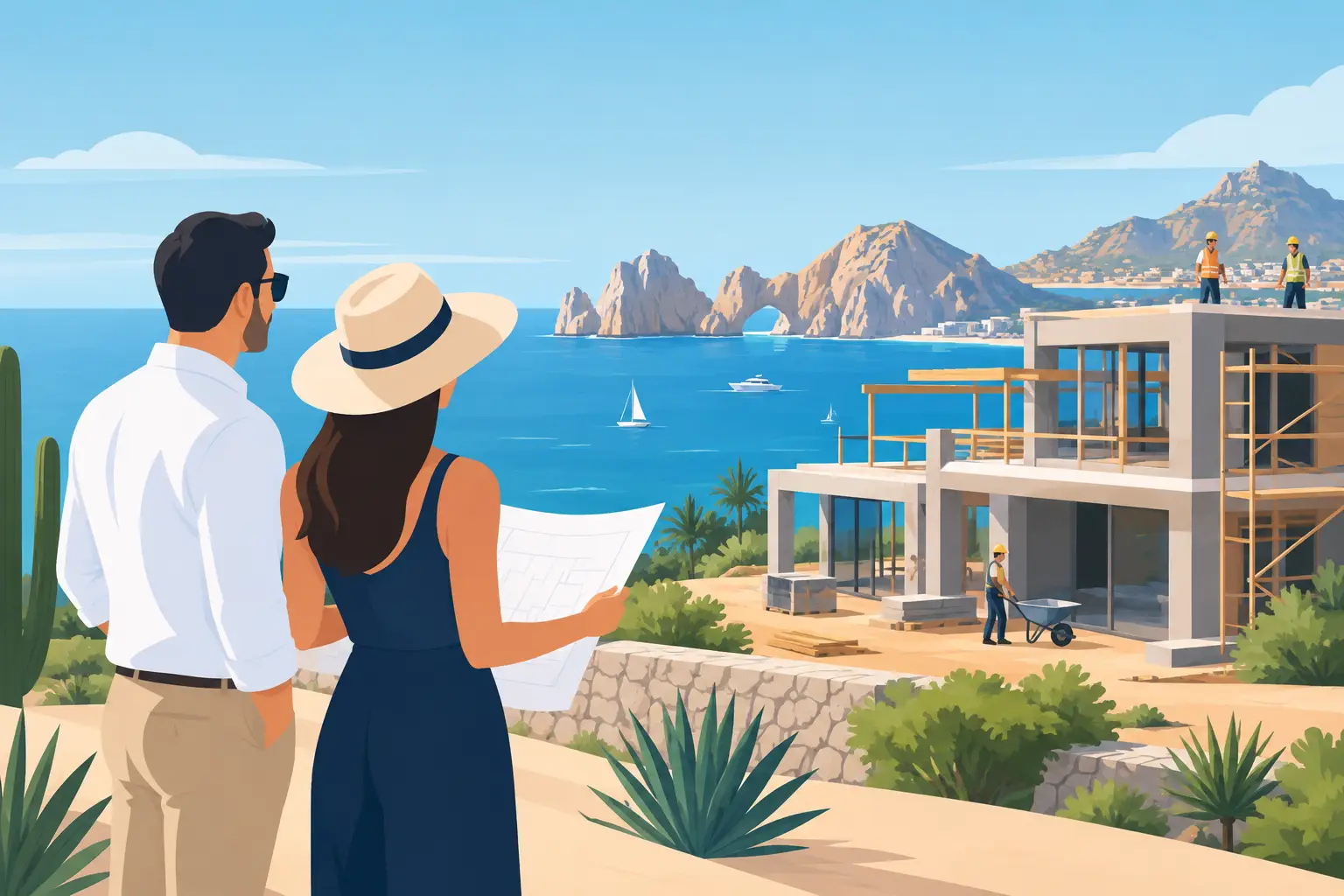
A luxury home in Los Cabos can be a rewarding investment, but it should never be managed like a vacation purchase. A strong foreign buyer construction guide starts with the realities that affect every build: title structure, community rules, site conditions, permitting, trade coordination, material lead times, and who is accountable when you are 1,000 miles away. The right plan replaces uncertainty with Trust – Communication – Value from the first site visit through final delivery.
For U.S. and Canadian owners, the goal is not simply to build a beautiful home. It is to build with clear expectations, North American-level quality control, and one experienced team responsible for the result.
Start With the Land, Not the Floor Plan
Ocean views, desert terrain, and gated communities are part of what makes Los Cabos special. They also make due diligence essential. Before committing to a design, confirm what the land can support and what the neighborhood will allow.
A site may have slopes that affect retaining walls and foundation design, limited access for equipment, utility requirements, or drainage considerations during seasonal storms. A spectacular view lot can require more structural planning than a flat parcel. That does not make it a poor choice. It means the project budget and schedule must reflect the actual conditions rather than an early rendering.
If the property is within Palmilla, Puerto Los Cabos, Querencia, Chileno Bay, Pedregal, Diamante, Campestre, or another planned community, review the architectural guidelines early. Many communities have requirements for height, setbacks, exterior materials, construction access, work hours, and design review. An experienced builder coordinates the home design around these rules instead of discovering conflicts after plans are underway.
Foreign buyers should also understand the ownership and closing structure for their particular property. Coastal-zone purchases commonly involve a bank trust arrangement known as a fideicomiso, while other ownership structures may apply depending on the property and buyer. Your real estate attorney and notary should guide the legal side. Your construction team should verify that the site documents, boundaries, access, and development conditions support the home you intend to build.
Choose a Builder With Real Operational Control
The greatest risk in a remote construction project is not that a problem will arise. Every custom build requires decisions and adjustments. The real question is who has the authority, skill, and presence to solve issues quickly without passing responsibility from one subcontractor to another.
A foreign buyer should ask how the contractor is staffed. Does the company rely almost entirely on outside crews? Who oversees concrete, electrical, plumbing, carpentry, pools, and finish work? Who checks the work against the drawings and specifications? Who answers when an owner has a question on a Friday afternoon?
A contractor with an established in-house workforce has more control over sequence, workmanship, and accountability. At Custom Homes Mexico, architects, calculation engineers, electricians, plumbers, carpenters, designers, pool technicians, solar engineers, and specialty trades work as part of a coordinated local team. That structure matters when a design change affects mechanical systems, a pool elevation, lighting locations, or a delivery schedule.
Credentials deserve attention as well. Ask about code compliance, engineering coordination, safety procedures, supervision, and the standards used for critical systems. Red Seal-certified trade professionals and a team familiar with U.S. and Canadian expectations can make a meaningful difference in panel organization, plumbing layout, waterproofing details, equipment selection, and finish quality.
Lowest price is rarely the best measure of value. A low initial number can exclude site work, engineering, permits, allowances, equipment, or the supervision needed to maintain quality. A detailed, transparent scope is more useful than a quick estimate that leaves major decisions for later.
Build the Budget Around the Full Scope
A construction budget should be developed in layers. The home itself is only one part of the investment. Site preparation, structural work, permits, utility connections, exterior hardscape, landscaping, pool construction, solar equipment, cabinetry, appliances, glazing, and furnishings can all materially affect the final number.
For a high-end Los Cabos residence, outdoor living deserves early budget attention. Infinity-edge pools, fire features, shaded terraces, outdoor kitchens, hurricane-resistant glazing, large sliding door systems, and ocean-facing retaining walls require coordinated engineering and installation. They should not be treated as decorative add-ons after the core construction budget has been set.
Allowances can be useful when selections are still evolving, but they must be specific. An allowance for tile, lighting, appliances, or plumbing fixtures should state the included amount, selection process, and how upgrades are handled. This protects both the owner and builder from misunderstandings.
It is also wise to maintain a contingency for owner-requested changes and conditions that cannot be confirmed until construction begins. The amount depends on the site, design complexity, and level of finish. A disciplined contingency is not a sign that the budget is uncertain. It is a practical way to make thoughtful decisions without disrupting the entire project.
Design for Baja, Not Just for the Renderings
The best Los Cabos homes are designed for the climate and for the way owners actually live. That means balancing open indoor-outdoor spaces with shade, privacy, wind exposure, salt air, drainage, energy use, and maintenance.
A dramatic glass wall may be ideal for a protected view corridor but require different specifications on an exposed coastal lot. Natural stone can be beautiful, but the right sealing and maintenance plan matters. A rooftop terrace can expand entertaining space, yet it needs proper waterproofing, drainage, rail details, and access for servicing equipment.
Energy planning should happen during design, not after completion. Solar can offset electrical demand, particularly when paired with efficient air conditioning, thoughtful glazing, insulation, lighting, and pool equipment. Mechanical and electrical systems should be sized for the home, its occupancy pattern, and the local climate, rather than copied from a plan built elsewhere.
This is also the time to plan practical owner priorities: a lock-off suite for guests, secure owner storage, a home office with dependable connectivity, equipment rooms with service access, water storage, and remote monitoring for a second home. Good design makes these systems feel invisible, but they require early coordination.
Make Communication Part of the Construction Contract
Distance does not have to mean lack of control. It does mean communication needs a defined rhythm. Before work begins, agree on who the primary contacts are, how approvals will be documented, when progress reports will be provided, and how changes affect cost and timing.
Regular photo and video updates give owners visibility into work that cannot be evaluated from a finished rendering. They also create productive conversations at key milestones: excavation, foundation, structure, rough-in, waterproofing, finishes, pool work, and final commissioning. For many owners, planned site visits at a few major decision points are more valuable than frequent unstructured trips.
Change orders should be clear and written. A proper change order identifies the requested change, cost impact, schedule impact, and approval before the work moves forward. This may feel formal, but it is one of the strongest protections available on a custom project. It prevents assumptions and keeps the budget honest.
Ask for a realistic construction schedule with meaningful milestones. Weather, community access restrictions, material availability, and owner selections can affect timing. A dependable builder will explain these variables directly rather than promise a date that cannot be supported by the scope and procurement plan.
Inspect the Work Before You Take Delivery
A final walkthrough should not be the first quality-control discussion. Quality is built through supervision at every stage, from rebar placement and concrete pours to waterproofing, electrical rough-in, tile setting, and equipment startup.
Still, a pre-delivery inspection is valuable. Review doors, windows, cabinetry, paint, stone, lighting, plumbing fixtures, pool equipment, air conditioning, and smart-home systems. Confirm that manuals, warranties, keys, remotes, and maintenance instructions are organized for the owner or property manager. Create a punch list with responsible parties and completion dates.
For buyers who own an existing home, an independent home inspection can also identify priorities before committing to a renovation, pool redesign, solar installation, or major remodel. It is often less expensive to identify water intrusion, electrical concerns, aging equipment, or structural issues before design decisions are finalized.
Build With a Team You Can Reach
A Los Cabos home should feel like a place to enjoy, not a project you have to chase from another country. The most successful foreign-owned builds begin with candid questions, detailed planning, and a builder that can coordinate the complete job on the ground.
Choose a team that will explain the trade-offs, document the decisions, protect the schedule, and stand behind the work. When communication remains clear from the first survey through move-in, building in Los Cabos becomes what it should be: a confident step toward a home built around your life.