
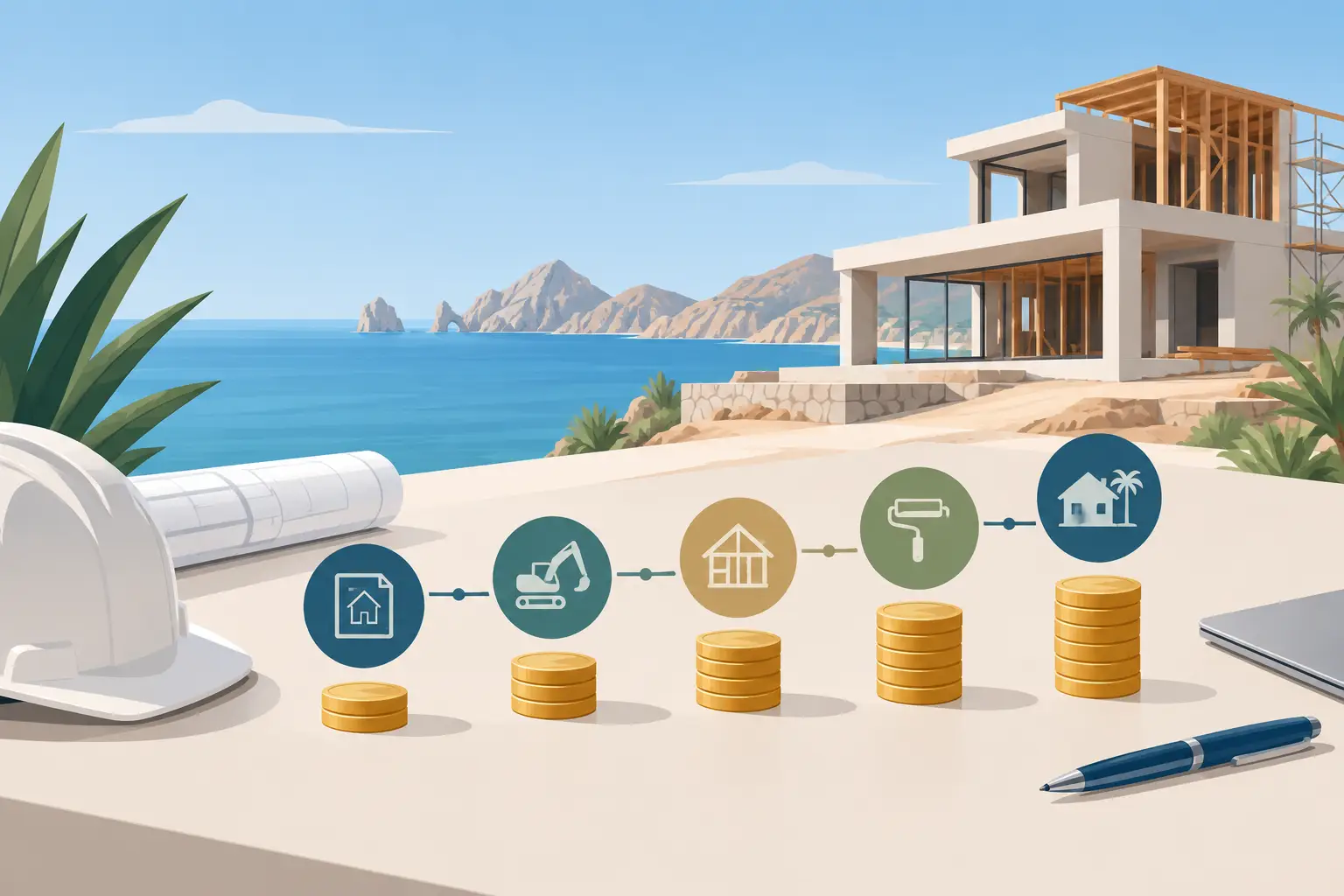
A custom home in Los Cabos can involve hundreds of decisions, multiple specialty trades, imported materials, and a construction schedule that must be managed from another country. A clear guide to payment milestones gives you a practical way to protect your investment: funds are released when defined work is complete, visible, and verified, not simply because a date has arrived.
For U.S. and Canadian owners, this structure creates accountability without slowing down a well-run project. It connects the construction budget to real progress in the field and gives both owner and builder a shared definition of what happens next. Trust, communication, and value are easier to maintain when expectations are written down before the first payment is made.
Why Payment Milestones Matter on a Cabo Home Build
A payment schedule is more than an accounting document. It is part of the project management system. The right milestones provide the builder with the cash flow needed to keep qualified labor, materials, equipment, permits, and specialty systems moving forward. At the same time, they give the owner objective checkpoints for confirming that the work meets the agreed scope and standard.
This matters especially for a cross-border project. You may be in California, Texas, Arizona, British Columbia, or Ontario while excavation, structural concrete, electrical rough-in, and finish carpentry are happening in Baja California Sur. You need a team that can explain progress in plain language, provide documentation, and answer questions quickly.
The alternative is a vague schedule with large upfront payments and unclear deliverables. That arrangement places unnecessary risk on both parties. A builder may be unable to plan purchasing and staffing effectively, while an owner may not know whether the amount paid is proportional to the work in place.
A Practical Guide to Payment Milestones
Every custom residence has its own site conditions, architectural complexity, community requirements, and finish level. A hillside home in Pedregal does not have the same construction sequence as a beachfront residence in Puerto Los Cabos or an extensive renovation in Palmilla. Still, a strong payment structure generally follows the natural stages of construction.
1. Preconstruction, Design, and Planning
The first milestone commonly covers the work required to turn your goals into a buildable project. Depending on the agreement, this can include architectural design, engineering coordination, site evaluation, budgeting, permit preparation, and construction planning.
This is a meaningful phase, not a formality. It is where the team identifies structural requirements, drainage conditions, solar orientation, mechanical needs, homeowner association rules, and the choices that will drive the final budget. Paying for this work upfront is reasonable when the scope, deliverables, and ownership of plans are clearly stated.
Before approving this milestone, make sure you understand what is included in the preliminary budget versus the final construction agreement. Conceptual estimates are valuable for decision-making, but they should not be treated as a fixed price before drawings, specifications, and site conditions are sufficiently defined.
2. Mobilization and Site Preparation
Once permits, contracts, and construction readiness are in place, the project moves into mobilization. This can include temporary utilities, site access, safety measures, project supervision, equipment staging, surveying, excavation, and early material orders.
A mobilization payment should have a specific purpose. It should not be an undefined deposit. Ask what work will begin, which long-lead materials must be secured, and what reports or site updates you can expect as the project starts.
For homes in master-planned communities, the schedule may also need to account for access rules, work-hour limits, approval procedures, and delivery restrictions. An experienced local builder plans around those realities rather than treating them as unexpected delays.
3. Foundation and Structural Completion
The foundation and structure are among the most important milestones because they establish the long-term performance of the home. Work may include excavation, footings, retaining walls, reinforced concrete, blockwork, structural steel, slabs, stairs, and roof structure.
This stage is often divided into more than one payment because of its size and material intensity. A foundation payment may follow completed excavation and reinforced footings, while a structural payment may follow the finished frame or roof slab. The exact division depends on the design and payment terms.
Do not evaluate this stage only by what is visible from the street. Ask for confirmation of reinforcing steel placement, concrete work, structural inspections, and engineering coordination where applicable. Quality control is not a decorative finish applied later. It begins below grade and inside the structure.
4. Building Envelope and Rough-In Systems
When the structure is protected from the elements, the project begins to take on the appearance of a home. This milestone may cover roofing, waterproofing, exterior walls, windows and doors, and early exterior finishes. At the same time, electricians, plumbers, HVAC technicians, and other specialists complete rough-in work behind walls and above ceilings.
This is a point where coordination matters greatly. A luxury home may include whole-home automation, security, pool equipment, solar infrastructure, water filtration, custom lighting, and outdoor kitchen systems. Each requires planning before finishes close up the walls.
Confirm that the payment description addresses both installed work and materials stored for your project. Some high-value items must be ordered well in advance. It can be appropriate to fund them before installation, provided they are documented, assigned to your project, and protected from loss or damage.
5. Interior Finishes, Exterior Living, and Specialty Work
Finish-stage payments typically cover drywall, flooring, millwork, cabinetry, stone, paint, fixtures, glazing, landscaping, pools, and exterior living areas. This phase can feel fast because there are many visible changes, but it is also where small omissions can become expensive.
The best approach is to connect payment releases to defined areas or scopes rather than relying on a general statement that the home is “mostly finished.” For example, cabinetry may be installed while countertops are pending, or a pool shell may be complete while tile and equipment commissioning remain. Precision prevents confusion.
Owners should expect regular conversations about selections and allowances during this phase. If you choose a different imported tile, premium appliance package, or upgraded outdoor lighting plan, the cost and schedule effect should be discussed before the change is ordered. Changes are normal in a custom project. Unrecorded changes are where budgets lose control.
What Should Be Verified Before Each Payment?
A milestone does not need to create an adversarial inspection process. It should create a reliable rhythm: the builder presents completed work, the owner receives clear information, questions are addressed, and the project advances.
Before authorizing a payment, review the agreed milestone description alongside current progress. A professional update should make it easy to identify what has been completed, what is in progress, and what comes next. For major stages, request documentation that fits the scope, such as:
- Progress photos or video from the site
- A written status report tied to the construction schedule
- Current budget information, including approved changes
- Relevant inspection, engineering, or testing records
- Confirmation of materials ordered, delivered, or installed
Not every payment requires the same level of documentation. A small finish-selection allowance is different from a structural concrete milestone. The key is proportional oversight. The higher the value and the harder the work is to inspect later, the more specific the verification should be.
Avoid These Payment Schedule Mistakes
First, avoid releasing payments based solely on calendar dates. Weather, permit timing, community access, material availability, and owner selections can all affect a schedule. Dates remain important, but completion of defined work should be the primary trigger for payment.
Second, do not rely on generic descriptions such as “construction progress” or “next phase.” Each milestone should identify the scope, amount, approval process, and any conditions for release. If a payment includes materials, clarify whether they are installed, stored on site, or held by a supplier.
Third, do not wait until the final walkthrough to identify open items. A well-managed builder tracks punch-list work as the project approaches completion. Retaining a reasonable final amount until final corrections, system testing, documentation, and handover are complete can protect the owner without unfairly withholding payment for finished work.
Finally, be cautious about choosing the lowest initial payment proposal without considering how the entire project is funded. An unrealistic schedule can create pressure later, especially if long-lead purchases, skilled labor, or specialty installations were not properly planned from the beginning.
Payment Milestones Work Best With One Accountable Team
A milestone schedule is only as useful as the team managing it. When design, engineering coordination, trades, and site supervision operate as disconnected parties, it becomes harder to determine who is responsible when an issue affects the budget or timeline.
Custom Homes Mexico uses an in-house team structure to maintain greater control over critical work, from planning through specialty systems and final delivery. For an owner building from abroad, that means fewer handoffs, clearer communication, and a single accountable partner when decisions need to be made.
The right payment schedule should leave you feeling informed, not pressured. Ask for a structure that reflects the real sequence of your home, supports quality work on site, and gives you clear evidence of progress at every major stage. That is how a Cabo build stays on time, on budget, and worthy of the investment you are making.